.avif)
Parapet Wall Repair: Protecting Your Home from Water Intrusion
Parapet walls are one of the most recognizable features of Southwestern architecture. They create the clean, flat rooflines commonly seen throughout Albuquerque and help conceal roofing materials, drainage systems, and rooftop equipment. Unfortunately, parapet walls are also one of the most common sources of water intrusion on stucco homes.
Because the top of a parapet is exposed directly to rain, snow, sunlight, and temperature changes, even a small crack can allow water to enter the wall. Once moisture gets behind the stucco, the resulting damage may extend far beyond the crack visible from the exterior. Understanding how parapet walls fail, and repairing them correctly, can help prevent costly damage to the stucco, roof, framing, insulation, drywall, and interior finishes of your home.
For homeowners with flat or low-slope roofs, parapet wall repair should be viewed as both a stucco issue and a roofing issue. If you are seeing cracks near the top of your parapet or water stains near the edge of your ceiling, our guide to roof leak repair in Albuquerque may also be helpful.
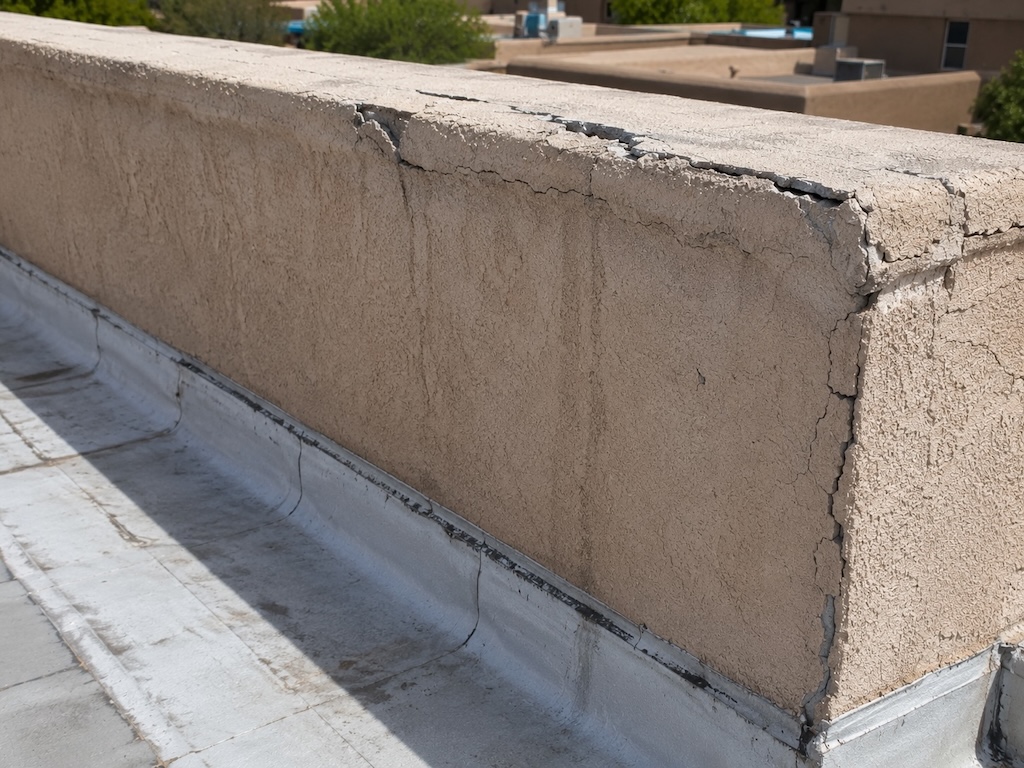
Why Parapet Caps Are Vulnerable
The horizontal or slightly sloped surface at the top of a parapet wall is known as the parapet cap. Unlike the vertical face of a stucco wall, the cap receives direct exposure to the weather. Albuquerque’s climate can be particularly hard on this surface because the parapet is exposed to intense summer sunlight, temperature swings, winter snow, ice, and seasonal moisture.
During the summer, direct sunlight heats the parapet during the day while temperatures may fall considerably overnight. During the winter, snow and ice can accumulate on the relatively flat cap. As that snow and ice melts, water can be absorbed into small cracks or porous areas of the stucco and then freeze again when temperatures drop. This repeated expansion and contraction can eventually create cracks in the stucco or protective coating.
Water may enter through cracks across the top of the parapet, failed sealant joints, deteriorated stucco, openings around canales and scuppers, poor roof-to-wall transitions, damaged waterproofing, or penetrations through the top of the parapet. The opening that allows water into the wall may be very small, but once water gets behind the stucco, it can travel through the wall assembly and appear somewhere entirely different.
Good Stucco on the Cap Is Crucial
Maintaining the stucco on the parapet cap is essential to preventing water intrusion. The cap should remain solid, properly sloped, and free from cracks, loose material, and failed coatings. A common mistake is to treat visible cracks with a small amount of caulk or elastomeric coating without determining how far the damage extends. That may temporarily reduce water entry, but it does not correct loose stucco, deteriorated reinforcing material, or failed waterproofing beneath the surface.
A proper parapet repair may require removing damaged material until solid, well-bonded stucco is reached. The contractor can then inspect the underlying lath, substrate, waterproof covering, and roof-to-wall transition before rebuilding the damaged area. The repaired cap should direct water away from vulnerable joints rather than allowing it to pond.
Compatible base coats, reinforcing mesh or lath, finish materials, sealants, and protective coatings should be used to create a complete repair system. Simply filling the visible crack may conceal the symptom without addressing the source. For more information on how stucco repairs are evaluated and priced, see our Stucco Repair Cost in Albuquerque guide.
The Waterproofing Beneath the Stucco Matters
Stucco is not intended to serve as the primary waterproofing layer protecting a parapet. A properly constructed plastered parapet should include a continuous waterproof cover or weather barrier across the entire top of the wall. That protective layer should wrap over the cap and extend down both sides of the parapet. On the roof side, it must integrate with the roofing felts or membrane so water cannot enter behind the roof-to-wall transition.
This detail is important because the stucco finish is exposed to movement, weathering, and eventual cracking. If the waterproofing beneath the stucco is missing, damaged, or poorly integrated with the roof, even small surface defects can allow water into the wall assembly.
Current residential requirements in New Mexico specifically address this condition. Plastered parapets must have a seamless waterproof covering over the entire cap, extending down both sides and properly overlapping the roofing system. Penetrating fasteners are not permitted through the horizontal top surface because every penetration creates another potential entry point for water. This requirement reflects how often improperly protected parapets have contributed to roof and wall leaks throughout New Mexico.
Low Parapets and Roofing Membrane Requirements
Local roofing requirements have also become more protective of short parapet walls. When a parapet does not extend at least 12 inches above the roof surface, the roofing membrane is required to continue up the inside face and completely over the top of the parapet. Wrapping the membrane over a low parapet creates a more continuous waterproof assembly and reduces dependence on the stucco cap alone.
For taller parapets, the roof membrane may terminate on the inside face of the wall, but the cap still requires its own properly installed waterproof covering that overlaps and seals to the rising roof membrane. Requirements can vary depending on the roof system, existing construction, permit scope, and governing jurisdiction. The roof and parapet should therefore be evaluated together rather than treated as unrelated components.
This is especially important when replacing an older flat roof. Many Albuquerque homes still have older built-up roofing systems that are now being replaced with TPO. If your home has an aging flat roof, our article on built-up roofing vs. TPO explains why TPO is often the modern replacement option for older built-up roof systems.
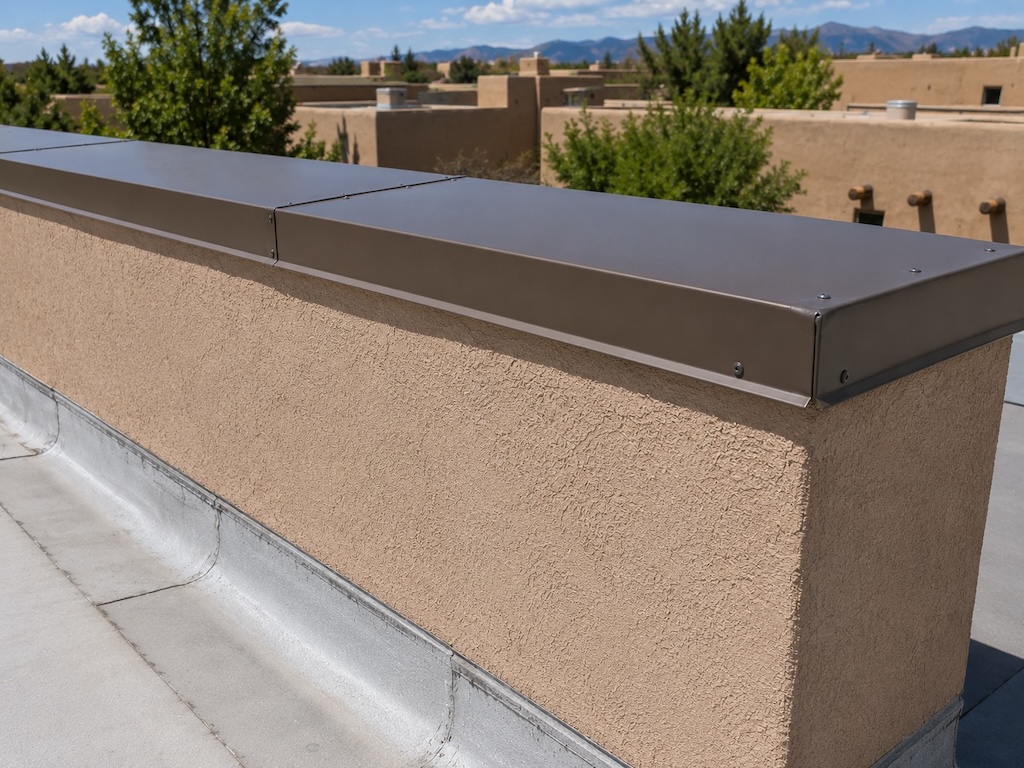
Sheet Metal Parapet Caps
Another option is to install a fabricated sheet metal cap, commonly called a parapet cap or coping, over the top of the parapet. A properly designed metal cap provides a durable barrier that sheds water before it reaches the stucco surface. The cap typically extends across the top of the wall and turns down along both the front and back sides, with properly detailed joints, corners, end conditions, drip edges, and securement.
Sheet metal coping can offer several advantages. It provides longer-lasting protection for the parapet cap, reduces ongoing maintenance, limits exposure of horizontal stucco surfaces, reduces recurring crack repairs, improves water runoff, and adds protection at joints and corners. However, metal caps still need to be designed and installed correctly. Poorly designed joints, incorrect fastening, inadequate slope, missing drip edges, or poorly sealed seams can still allow water intrusion.
The main disadvantages are appearance and upfront cost. For homeowners who prioritize a traditional Southwest look, a metal parapet cap creates a more commercial or contemporary appearance than a traditional stucco cap. For homeowners who prioritize function and lower maintenance, the added durability can be a significant benefit.
Cost is also a factor. As a rough example, parapet stucco repairs on a typical home may be around $30 per lineal foot, while sheet metal caps for the same home may be closer to $50 per lineal foot, depending heavily on parapet width, access, detailing, corners, and total scope. The ongoing maintenance cost should also be considered. Stucco parapet caps should be inspected every other year at a minimum, and even properly installed work can develop hairline cracks on horizontal surfaces that need to be addressed quickly. Metal caps should also be inspected every two to three years, but they may require little or no work for many years beyond periodic sealant maintenance at seams and joints.
Signs Your Parapet May Need Repair
Homeowners should inspect parapets periodically and after major storms. Warning signs include cracking across the top of the wall, loose or hollow stucco, crumbling material, peeling coatings, dark staining below the parapet, white mineral deposits, damaged corners, open joints around canales or scuppers, bubbling paint inside the home, soft drywall near exterior walls, or repeated roof leaks that have not been resolved.
A parapet problem is often mistaken for a roof leak because the water appears near the roofline. In many cases, the roof membrane may be performing properly, but water is entering through the wall above it. This is one reason repeated roof patching does not always solve the problem. If the parapet cap, wall transition, or waterproofing beneath the stucco is allowing water into the assembly, the leak may continue until the parapet is repaired correctly.
For homeowners trying to determine whether a flat roof issue is related to the roof surface, parapet, scupper, or drainage condition, our article on flat roof repair issues in Albuquerque explains what to look for.
Repair the Wall and Roof as One System
Successful parapet repair requires more than applying new stucco to the visible damage. The contractor must consider the condition of the cap, waterproof covering, stucco reinforcement, roofing membrane, drainage openings, sealants, and transitions between materials. Repairing only one portion of the problem can leave a gap between the roofing and wall systems, and that gap may become the next leak.
This is where working with a contractor experienced in both roofing and stucco can be especially valuable. At Tate Construction Company, we evaluate the entire assembly to determine where water is entering and what must be repaired to provide a lasting solution. Depending on the condition of the wall, that may involve localized stucco repair, rebuilding portions of the parapet, correcting roofing transitions, installing new waterproofing, or adding fabricated sheet metal caps.
If the parapet damage is part of a larger flat-roof problem, you can also use our roof replacement cost estimator to get a preliminary replacement range for a flat or combination roof before scheduling an on-site evaluation.
Protect Your Flat-Roof Home
Keeping parapet walls properly maintained is one of the most important steps Albuquerque homeowners can take to protect a flat-roof home. Addressing small cracks before water enters the wall is considerably easier and less expensive than repairing widespread moisture damage later.
Tate Construction Company provides roofing services, stucco services, parapet repair, and exterior construction services throughout Albuquerque, Rio Rancho, Corrales, Placitas, and surrounding communities. If your parapets are cracked, stained, leaking, or repeatedly patched, we can evaluate the roof and wall assembly together and recommend the right repair.
To schedule an inspection, contact Tate Construction Company.